

Climate Mitigation
Climate Mitigation

Significance & Commitment
Climate change is a critical global issue, prompting international cooperation to cease the escalation of global average temperature by restraining the amount of greenhouse gas emissions through the implementation of stringent regulations in each country. As an energy producer, Banpu is committed to achieving Net Zero emissions by 2050. This commitment is reinforced by the corporate strategy “Energy Symphonics,” which harmonizes innovation, technology, and sustainability to guide Banpu’s transition toward a low-carbon, resilient energy future.
Management Approach
Climate change risks are fully integrated into the Company’s enterprise risk management, reflecting the strategic importance of a proactive climate response. To reinforce accountability, climate change management has been designated as a key performance indicator for the CEO and senior executives in relevant business units.
A dedicated Climate Change Committee has been established to oversee the implementation and performance of the Company’s climate strategy, which focuses on four measures: Mitigation of emissions, Climate-related adaptability, Participation in a low-carbon society, and Participation in a climate change community.

Mitigating
GHG emissions

Adaptation

Being a part in
a low carbon society

Participation in a climate change community
Banpu’s Journey to Net Zero
The journey to Net Zero is a comprehensive and ambitious effort to reduce GHG emissions as close to zero as possible. Banpu has identified 3 key steps to this transition: calculating emissions across all scopes (Scope 1, 2, and 3), setting targets, and developing decarbonization pathways.
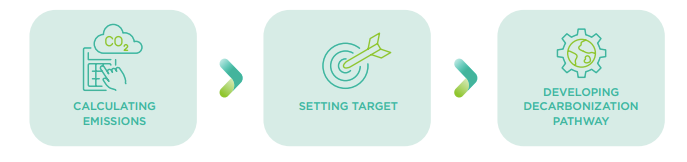
Calculating Emissions: To understand our current baseline, Banpu has comprehensively calculated and disclosed Scope 1 and 2 emissions from assets under our operational control. We are currently in the process of estimating Scope 3 emissions, with a commitment to fully calculate and disclose the top three emission sources by 2026.
Setting Target: To align with global efforts to limit global warming to 1.5°C, Banpu has committed to becoming a net zero emissions company by 2050. As part of our interim goal, we commit to reducing GHG emissions by at least 20% by 2030, using 2023 as the base year.
Developing Decarbonization Pathway: A crucial aspect of achieving net zero is the implementation of effective decarbonization plans. This requires operational improvements, adopting new technologies, and ongoing performance monitoring. Banpu has incorporated our decarbonization plan into the annual business strategy workshops. In addition, these initiatives are overseen by the Climate Change Committee on a quarterly basis.
Scope 1 and 2 Emissions Sources
The Company has undertaken an analysis to identify the sources of GHG emissions for each business. The analysis covers GHG emissions scope 1 and scope 2..
Business
Key activity
GHG source
(Scope 1)
GHG source (Scope 2)
Diesel
Biodiesel
Gasoline
Coal
Methane
Explosive
HFCs
SF6
CaCO3
Waste gas
Natural gas
Electricity imported
Mining
Electricity generation
•
•
•
Coal extraction
•
•
•
•
•
Coal hauling
•
•
•
•
Coal seam & stockyard
•
•
•
Barging
•
•
Supporting activities
•
•
•
•
Thermal power
Boiler
•
•
•
•
Coal stockyard
•
•
•
Air quality control
Substation
•
•
•
Auxiliary system
•
Supporting activities
•
•
•
•
Renewable power
Auxiliary system
•
•
•
Supporting activities
•
•
•
•
•
•
Solar rooftop
Auxiliary system
•
•
Supporting activities
•
•
Solar rooftop
Auxiliary system
•
•
•
•
•
Year in Review
In 2024, Banpu set both interim and long-term targets in line with the Paris Agreement goal of limiting global temperature increases to below 1.5°C. To meet these targets, decarbonization has been fully integrated into our strategic planning, emphasizing climate-related risks and opportunities within our business strategy.
The Banpu Innovation Program now includes decarbonization criteria, focusing on projects that contribute to emissions reduction and the generation of carbon credits. In parallel, we are actively exploring and evaluating several initiatives across the organization, such as improving boiler energy efficiency, utilizing methane (CH₄) for energy, and installing solar photovoltaic systems for internal use. In addition, we have expanded our GHG Scope 3 emissions disclosure to cover 7 categories across the group.
 English
  Thai
Thai